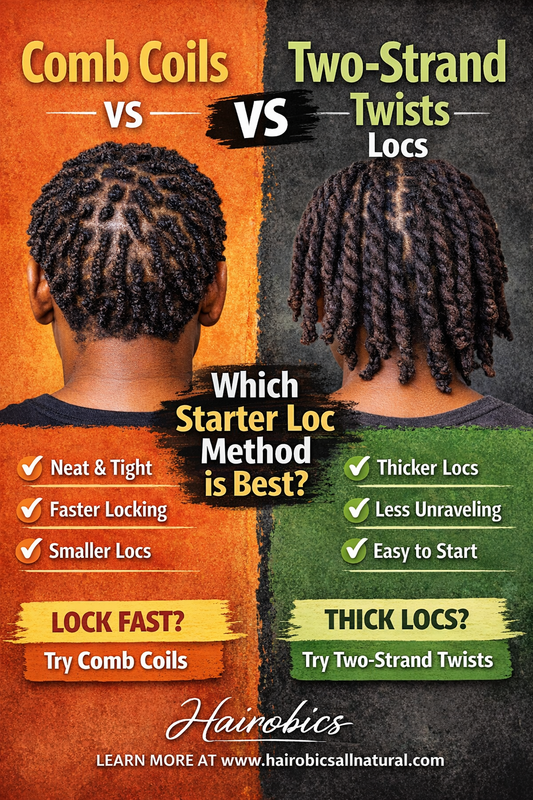
Starting locs is one of the most exciting moments in a natural hair journey. But before your locs mature into thick, beautiful ropes of hair, there is an important decision to make:
How should you start them?
Two of the most popular starter loc methods are:
-
Comb coils
-
Two-strand twist locs
Both methods can create beautiful locs, but they behave very differently during the early stages of locking. The method you choose can affect:
-
How neat your starter locs look
-
How quickly they lock
-
How thick your locs become
-
How much maintenance they require
Understanding the differences between comb coils and two-strand twists can help you start your loc journey the right way.
In this complete guide, we’ll break down everything you need to know about:
-
How each method works
-
The pros and cons of each
-
Which hair types they work best for
-
Maintenance requirements
-
Which method creates thicker locs
-
Which method locks faster
-
What most locticians recommend
By the end of this guide, you’ll know exactly which starter loc method is right for you.
What Are Starter Locs?
Starter locs are the very first stage of the loc journey.
Instead of allowing hair to remain loose, the hair is intentionally sectioned and formed into patterns that will eventually lock together over time.
Over months (and years), the hair strands:
-
intertwine
-
mat together
-
compress
-
form a solid rope-like structure
This process is called locking or matting.
The starter method you choose determines the initial shape and structure of the loc.
Common starter loc methods include:
-
Comb coils
-
Two-strand twists
-
Braids
-
Instant locs
-
Interlocking
-
Freeform
However, comb coils and two-strand twists are the two most common methods used in salons.
What Are Comb Coil Locs?
Comb coils are small spiraled coils created with a comb.
The stylist takes a small section of hair and uses a rat-tail comb to twist the hair into a coil.
The hair wraps around itself, forming a tight spiral pattern.
Each coil eventually mats together and forms a loc.
How Comb Coils Are Created
The process usually includes:
-
Hair is washed and clarified
-
Hair is sectioned into loc parts
-
Styling gel or locking cream is applied
-
The stylist twists the hair with a comb
-
The hair forms a small spiral coil
The result is a very neat starter loc style.
Comb coils are extremely popular for people who want their locs to start with:
-
clean parts
-
uniform size
-
professional salon appearance
Pros of Comb Coil Locs
1. Very Clean and Neat Look
Comb coils create some of the cleanest starter locs possible.
The parts are crisp, and the coils look uniform.
This makes them popular for people who want a professional appearance from day one.
2. Faster Locking for Some Hair Types
Comb coils tend to lock faster than twists because the hair is already wrapped around itself.
This makes it easier for strands to begin matting.
3. Smaller, More Defined Locs
Comb coils are ideal if you want:
-
small locs
-
medium locs
-
high loc density
People who want hundreds of locs usually start with comb coils.
4. Easy Retwisting
Comb coil locs are easy to maintain with traditional palm rolling and retwisting.
This keeps the roots neat as the locs mature.
Cons of Comb Coil Locs
1. They Can Unravel Easily
One of the biggest issues with comb coils is unraveling.
If the hair texture is soft or loose, coils can unravel after washing.
2. Shrinkage Happens Fast
Comb coils can shrink quickly as they begin locking.
Many people are surprised when their coils become much shorter in the first few months.
3. Not Ideal for Loose Curl Patterns
People with looser textures (3A–3C) may struggle with comb coils staying intact.
Twists often work better for these textures.
What Are Two-Strand Twist Locs?
Two-strand twist locs start by twisting two sections of hair together.
This method is extremely common for people starting locs at home.
Instead of coiling hair with a comb, the stylist:
-
divides hair into sections
-
splits the section into two strands
-
twists the strands around each other
Over time, the hair begins locking inside the twist pattern.
Eventually the twist pattern disappears and becomes a loc.
Pros of Two-Strand Twist Locs
1. Very Durable Starter Locs
Twists hold together better than comb coils.
They are less likely to unravel, especially after washing.
2. Great for Softer Hair Textures
People with:
-
looser curls
-
soft hair
-
mixed textures
often find that twists hold better than coils.
3. Fuller Looking Locs
Twists often create thicker locs.
This is because two strands of hair are combined into one structure.
4. Easier DIY Method
Two-strand twists are one of the easiest starter loc methods to do yourself.
Many people start their loc journey at home using this technique.
Cons of Two-Strand Twist Locs
1. The Twist Pattern Can Last a Long Time
One downside is that the twist pattern can remain visible for months.
Sometimes the twist pattern can last 6–12 months.
Some people love the look.
Others prefer a smoother loc appearance.
2. Slower Locking Process
Twists sometimes take longer to lock compared to comb coils.
Because the hair is twisted rather than coiled, it takes longer for the strands to fully mat together.
3. Loc Count May Be Lower
Because twists are thicker, you may end up with fewer locs overall.
If someone wants very small locs, twists may not be ideal.
Comb Coils vs Two-Strand Twists: Key Differences
Here is a side-by-side comparison.
| Feature | Comb Coils | Two-Strand Twists |
|---|---|---|
| Starter look | Very neat | Slightly fuller |
| Locking speed | Faster | Slower |
| Unraveling risk | Higher | Lower |
| Best for tight curls | Yes | Yes |
| Best for loose curls | Sometimes | Better |
| Loc thickness | Smaller | Thicker |
| Maintenance | Regular retwist | Similar |
| DIY friendly | Moderate | Very easy |
Both methods can create beautiful locs.
The best option depends on your hair type and goals.
Which Method Locks Faster?
Comb coils typically lock faster.
Why?
Because the hair is already wrapped tightly around itself.
The strands begin matting together sooner.
Typical timeline:
Comb coils begin locking within 3–6 months.
Two-strand twists may take 6–12 months to fully mature.
However, locking speed also depends on:
-
hair texture
-
hair density
-
maintenance routine
-
washing frequency
Which Method Creates Thicker Locs?
Two-strand twists usually create thicker locs.
This happens because two strands are combined into one twist.
When the twist locks, the loc becomes larger.
Comb coils typically create:
-
smaller locs
-
medium locs
-
higher loc counts
So if you want:
-
microlocs
-
smaller locs
-
high density
comb coils may be the better option.
Which Starter Loc Method Lasts Longer?
Both methods can last a lifetime.
But two-strand twists are more durable early on.
They hold their shape better during:
-
washing
-
sweating
-
workouts
Comb coils require more care early in the journey.
Best Hair Types for Comb Coils
Comb coils work best for:
-
4A hair
-
4B hair
-
4C hair
These textures have tight curl patterns that coil easily.
The tighter the curl pattern, the easier the hair locks.
Best Hair Types for Two-Strand Twist Locs
Two-strand twists work well for:
-
3C hair
-
4A hair
-
4B hair
-
4C hair
Because the twist structure is stronger, it works better for softer textures.
How Long Do Starter Locs Take to Mature?
Regardless of method, locs mature in stages.
Stage 1: Starter Locs
First 0–3 months
Hair still looks like coils or twists.
Stage 2: Budding
Around 3–6 months
Hair begins forming small knots.
Stage 3: Teen Locs
Around 6–12 months
Locs begin thickening.
Stage 4: Mature Locs
After 12–18 months
Locs become fully formed.
How to Maintain Starter Locs
Proper maintenance is essential for healthy locs.
Key practices include:
Keep the Scalp Clean
Healthy locs start with a clean scalp.
Regular washing prevents:
-
dandruff
-
buildup
-
itching
Moisturize Regularly
Dry hair can cause breakage.
Lightweight sprays can keep locs hydrated.
Protect Hair at Night
Use:
-
satin bonnet
-
silk pillowcase
-
satin scarf
This reduces friction.
Avoid Heavy Products
Heavy oils and creams can create buildup.
Lightweight natural products are best.
Common Starter Loc Mistakes
Many beginners make mistakes that slow their loc journey.
Common issues include:
Over-Retwisting
Retwisting too often can weaken roots.
Most people should retwist every 4–6 weeks.
Using Too Much Product
Product buildup can slow locking.
Constantly Manipulating Locs
Too much twisting, styling, or pulling can cause thinning.
The Best Products for Healthy Loc Growth
Healthy locs require a healthy scalp.
Products that support scalp health can help promote stronger hair growth.
Look for ingredients like:
-
castor oil
-
rosemary oil
-
peppermint oil
-
tea tree oil
These ingredients help support scalp circulation and hydration.
Lightweight scalp oils and moisturizing sprays can help keep locs:
-
soft
-
healthy
-
hydrated
throughout the locking process.
Comb Coils vs Two-Strand Twist Locs: Which Should You Choose?
Choose comb coils if you want:
-
smaller locs
-
faster locking
-
very neat starter locs
-
high loc count
Choose two-strand twists if you want:
-
thicker locs
-
stronger starter style
-
less unraveling
-
easier DIY method
Both methods can produce beautiful locs.
The best method depends on your:
-
hair texture
-
loc size goals
-
maintenance preference
Final Thoughts
Starting locs is the beginning of an incredible natural hair journey.
Whether you choose comb coils or two-strand twist locs, the most important factor is patience.
Locs develop slowly, but over time they transform into one of the most unique and powerful natural hairstyles.
With proper care, moisture, and scalp health, your locs can grow:
-
thicker
-
longer
-
stronger
year after year.
The key is consistency, gentle maintenance, and letting your hair naturally evolve.