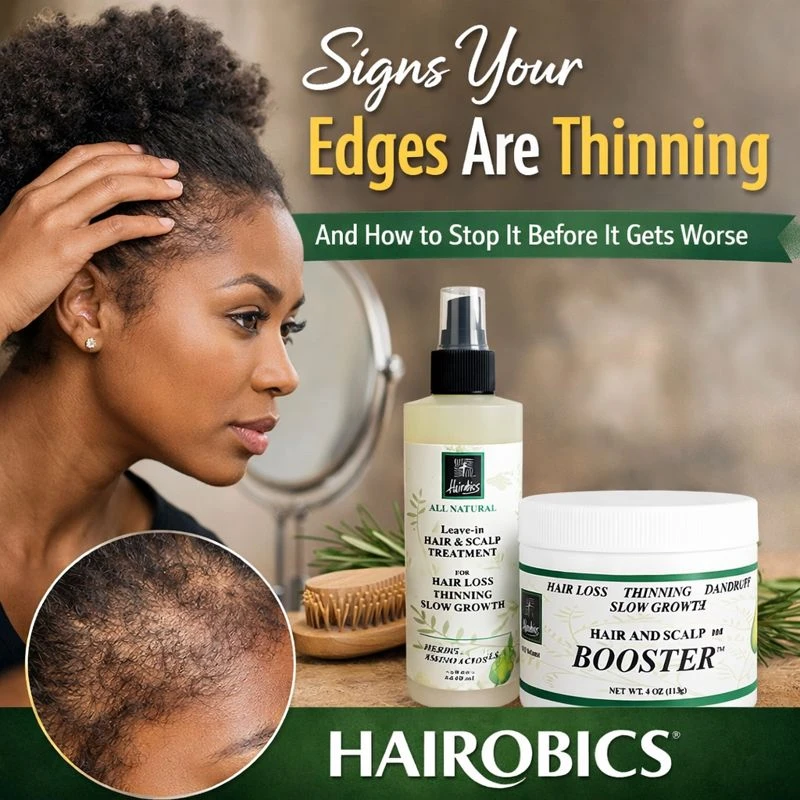
Thinning edges—also known as temple thinning or hairline breakage—are one of the most common (and emotional) hair concerns for women with natural, relaxed, braided, or loc’d hair. Your edges frame your face, protect your hairline, and play a huge role in how full and healthy your hair looks overall.
The tricky part?
Edges usually thin slowly, and by the time most people notice, damage has already been happening for months—or even years.
If you’ve been wondering whether your edges are thinning (or why they won’t grow back), this guide breaks it all down. You’ll learn:
-
Early and advanced signs of thinning edges
-
What’s causing the damage
-
How to stop edge thinning
-
How to regrow your hairline naturally
-
The best Hairobics products to support edge recovery
Let’s get into it.
What Are Edges—and Why Are They So Fragile?
Your edges are the fine, delicate hairs along your hairline, especially around the temples and nape. Unlike the rest of your hair, edge hair:
-
Has a shorter growth cycle
-
Is finer in diameter
-
Breaks more easily
-
Is more sensitive to tension, dryness, and friction
Because of this, edges are often the first place hair damage shows up.
Early Signs Your Edges Are Thinning
Catching thinning edges early makes all the difference. Here are the subtle warning signs many people miss.
1. Your Hairline Looks Wider Than It Used To
If your forehead appears larger or your hairline looks pushed back, thinning may already be happening.
Common causes:
-
Tight ponytails
-
Braids pulling at the temples
-
Lace wigs or frontals worn repeatedly
? Early intervention is critical at this stage.
2. Baby Hairs Aren’t Growing Back
Some baby hairs are natural—but baby hairs that never lengthen are often a sign of breakage, not growth.
If your edges:
-
Break off as soon as they grow
-
Stay short for months or years
-
Look sparse compared to old photos
That’s thinning—not “just baby hair.”
3. Your Edges Break When You Touch Them
Edges should be soft and flexible. If they:
-
Snap easily
-
Shed when brushing or styling
-
Feel dry even after moisturizing
Your hairline may be weakened from chronic dryness or stress.
? This is where consistent scalp and edge hydration matters most.
4. You Feel Tenderness or Soreness Along Your Hairline
Pain is not normal.
Tender edges can indicate:
-
Excessive tension
-
Early traction alopecia
-
Inflammation of hair follicles
Ignoring soreness often leads to permanent hair loss over time.
5. You Need Edge Control More Often Than Before
If you’re applying edge control daily just to “fake fullness,” that’s a red flag.
Heavy gels:
-
Dry out fine hairs
-
Cause buildup
-
Lead to breakage over time
Healthy edges don’t require constant manipulation.
Advanced Signs of Thinning Edges
If edge thinning has progressed, signs become more obvious.
6. Visible Scalp at the Temples
Seeing scalp through your edges—especially in good lighting—is a clear sign of thinning.
This is common in women who:
-
Wear tight protective styles back-to-back
-
Use heavy gels regularly
-
Don’t moisturize their hairline properly
7. Your Hairline Is Uneven
One side thinner than the other often means:
-
Side sleeping friction
-
Repetitive styling habits
-
Consistent tension on one side
Silk pillowcases and protective styling changes can help prevent further damage.
8. Edges Are Missing Completely in Certain Spots
This can indicate traction alopecia, which happens when hair follicles are damaged over time.
The good news?
If follicles aren’t permanently scarred, regrowth is still possible with the right routine.
What Causes Edges to Thin?
Understanding the root cause helps you fix the problem faster.
1. Tight Hairstyles
-
Braids
-
Ponytails
-
Slick buns
-
Sew-ins
-
Lace wigs
Even “protective” styles can be damaging if worn too tight.
2. Excessive Edge Control & Gels
Most edge controls contain:
-
Alcohol
-
Drying polymers
-
Heavy waxes
These ingredients dry out and weaken fine edge hair over time.
3. Dry Scalp & Hairline
Dryness leads to:
-
Breakage
-
Inflammation
-
Slow regrowth
Your edges need daily moisture, not just styling products.
4. Poor Scalp Circulation
Healthy hair growth depends on blood flow to the scalp.
Low circulation means:
-
Slower growth
-
Weak strands
-
Longer recovery time
5. Hormonal Changes & Stress
Postpartum hair loss, menopause, stress, and poor sleep can all contribute to edge thinning.
How to Stop Edge Thinning Immediately
Here’s what to do right now.
1. Eliminate Tension
-
Avoid tight styles
-
Skip slick-back looks
-
Give your hairline rest between styles
Your edges need time to breathe.
2. Moisturize Your Edges Daily
Dry edges don’t grow.
A lightweight daily mist like Hairobics Raaw Roots Moisturizing Spray helps:
-
Hydrate fragile hairline strands
-
Reduce breakage
-
Keep edges soft and flexible
3. Massage Your Hairline
Scalp massage boosts circulation and follicle health.
Using Hairobics Hair & Scalp Booster along the temples:
-
Stimulates dormant follicles
-
Strengthens weak roots
-
Supports regrowth naturally
Massage gently for 3–5 minutes, 3–4 times per week.
4. Nourish the Scalp With Oils (Not Grease)
Heavy greases clog follicles.
Natural oils feed them.
Hairobics Scalp Rejuvenator Oil contains botanical oils that:
-
Reduce inflammation
-
Strengthen hair at the root
-
Support healthier edges over time
Apply sparingly—consistency matters more than quantity.
5. Protect Your Hairline at Night
-
Satin or silk scarves
-
Satin pillowcases
-
Loose nighttime styles
This prevents friction-related breakage.
Can Thinning Edges Grow Back?
Yes—in most cases.
Edges can regrow if:
-
Follicles aren’t scarred
-
Tension is removed
-
Moisture is restored
-
Scalp health improves
Natural regrowth takes 8–16 weeks with consistent care.
Best Hairobics Routine for Thinning Edges
Here’s a simple, effective routine using Hairobics products.
Daily
-
Light mist of Raaw Roots Moisturizing Spray
-
Gentle finger massage along the hairline
3–4x Weekly
-
Apply Hair & Scalp Booster to edges
-
Massage for circulation
2–3x Weekly
-
Seal moisture with Scalp Rejuvenator Oil
Weekly
-
Wash with Hairobics Jamaican Black Castor Oil Shampoo
-
Deep condition to prevent dryness
Mistakes That Prevent Edge Regrowth
Avoid these if you want results:
-
Over-styling edges
-
Daily gel use
-
Skipping moisture
-
Being inconsistent
-
Expecting overnight growth
Healthy edges require patience.
How Long Does Edge Regrowth Take?
-
2–4 weeks: Reduced shedding & breakage
-
4–8 weeks: New baby hairs appear
-
8–16 weeks: Visible fullness improvement
Consistency beats everything.
Final Thoughts: Your Edges Can Recover
Thinning edges don’t mean permanent damage—but they do mean your hairline needs attention.
By:
-
Reducing tension
-
Hydrating daily
-
Nourishing your scalp
-
Using clean, botanical products like Hairobics
You give your edges the best chance to grow back stronger, fuller, and healthier.
Your edges are delicate—but with the right care, they’re resilient too.